| Piping |
| The mechanism of the piping phenomenon is still being studied around the world, but much remains unknown, making it a field of ongoing research. Here, we will introduce the mechanism currently understood. First, when river water levels rise during floods, water pressure rises accordingly. This causes water to seep into the ground from the river side (the area outside the levee). The seeping water then leaks into the area inside the levee (where people live), carrying and discharging sand along with it, creating a phenomenon known as sand boiling. The area where the sand is discharged becomes a pipe, and as this gradually develops, the amount of sand boiling increases. As a result, the pipe reaches the river surface and penetrates it. Once connected to the river surface, the flow rate within the pipe suddenly increases, widening the hole in the pipe and creating a passageway for water and sand. This can lead to levee subsidence, collapse, and, in the worst case scenario, levee failure. This is the entire process of the piping phenomenon. To date, there have only been a few cases of levee failures due to the piping phenomenon in Japan, but it is expected to become more common in the future due to the recent frequent occurrence of torrential rains and deterioration of levees. 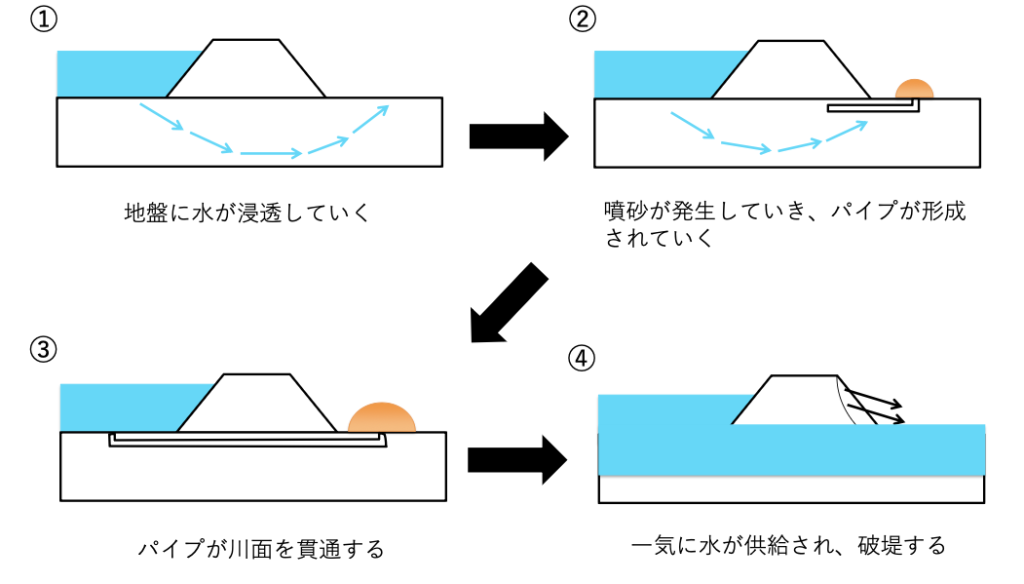 |
| Liquefaction |
| Liquefaction refers to a condition where effective stress (the force borne by soil particles) is lost, resulting in a significant decrease in strength and rigidity. This is because the external force acting on sand (total stress) is constant, calculated as the sum of effective stress and pore water pressure. Total stress σ = Effective stress σ’ + Pore water pressure u Total stress σ (constant) = Effective stress σ’ Small + Pore water pressure u Large Liquefaction When liquefaction occurs, the soil behaves like a liquid, and its strength and rigidity decrease to a fraction of one-tenth to a fraction of one-thousandth of what they were before liquefaction. This causes various damages and effects on structures on the ground surface and underground, such as ground subsidence and building tilting. Normally, soil has effective stress and resistance to shear (the shifting of objects in an alternating direction), but during earthquakes, it is subjected to repeated shear, loses its effective stress, and becomes liquid-like. When the ground is subjected to repeated shear due to an earthquake, soil (soil layers) that have no resistance to liquefaction liquefy. The stronger and longer the seismic motion, the larger the soil layer that liquefies. Liquefaction continues for a while even after the earthquake ends. After that, the excess pore water pressure dissipates (i.e., effective stress is restored) and liquefaction ends, but the sand becomes denser. 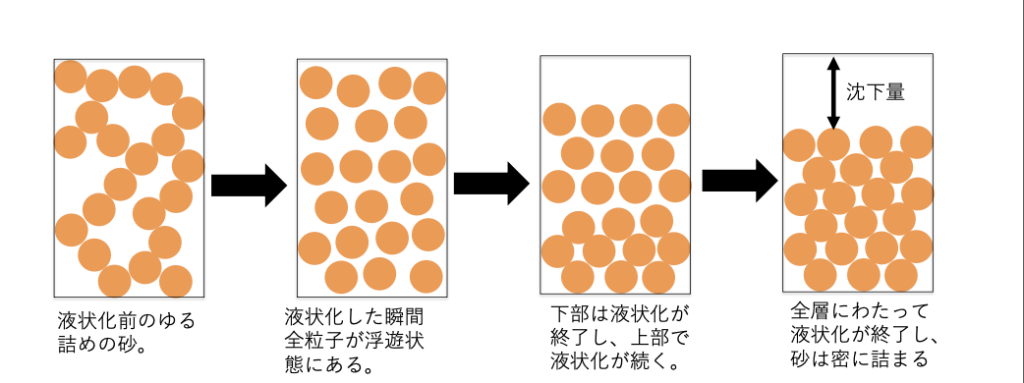 |