| Soil mechanics and its interdisciplinary fields (particularly with hydraulics). |
| We conduct interdisciplinary research in geotechnical engineering and other fields, particularly hydraulic engineering and river engineering. This will allow us to advance research in areas that have not been extensively studied before, such as the formation of cavities in the ground and subsidence, as well as piping failure of embankments. (Fig5-1)。 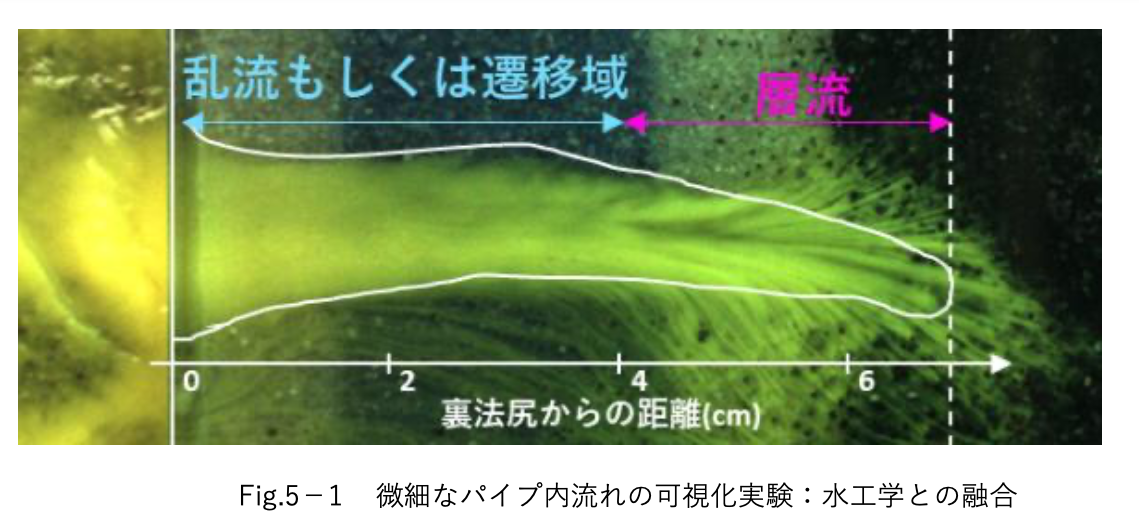 |
| Observing and modeling soil behavior through experiments |
The behavior of soil and ground is more complex than that of other materials, and there is a strong need to improve the accuracy of numerical simulations. Therefore, we conduct detailed experiments using actual soil to observe the phenomena and continuously verify and improve our theories.(Fig5-2)。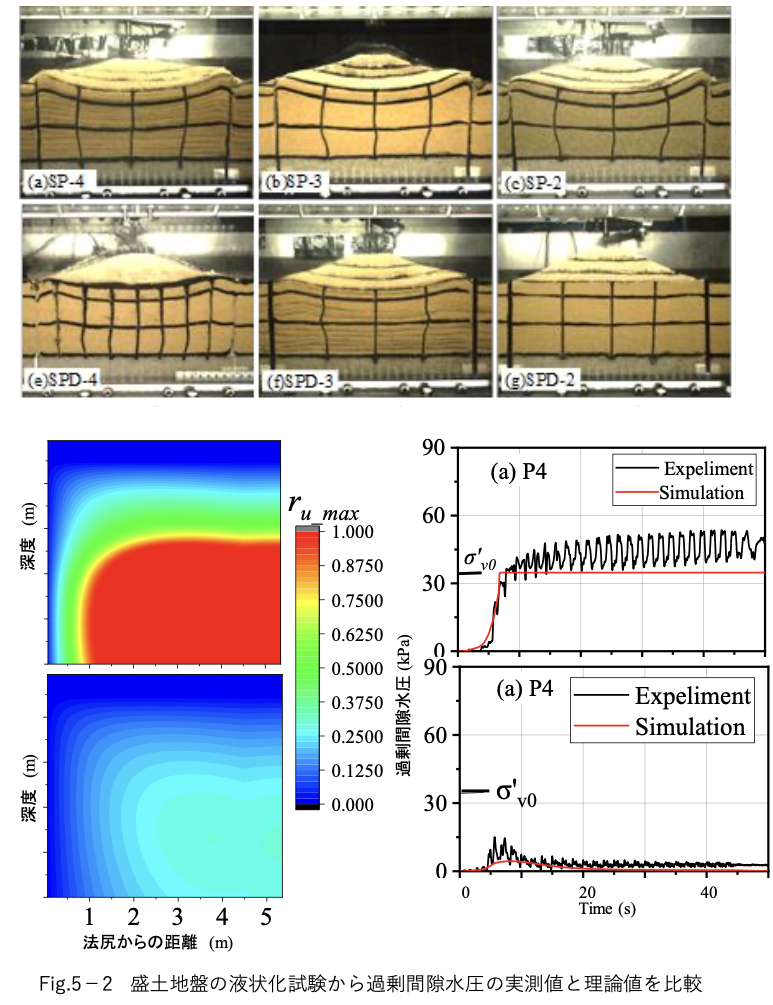 |
| Investigation and clarification of on-site behavior, and feedback to laboratory model experiments |
We investigate geotechnical engineering problems occurring at the field scale, such as damage to levees due to floods, slope failures due to heavy rainfall, liquefaction damage due to earthquakes, and on-site test construction. We still frequently encounter phenomena that cannot be explained by current scientific methods, and we bring them back to the laboratory to elucidate these phenomena. Furthermore, the results will be used to propose countermeasures for on-site recovery and prevention of future disasters.
Some examples
➀Landslide in Matsuyama
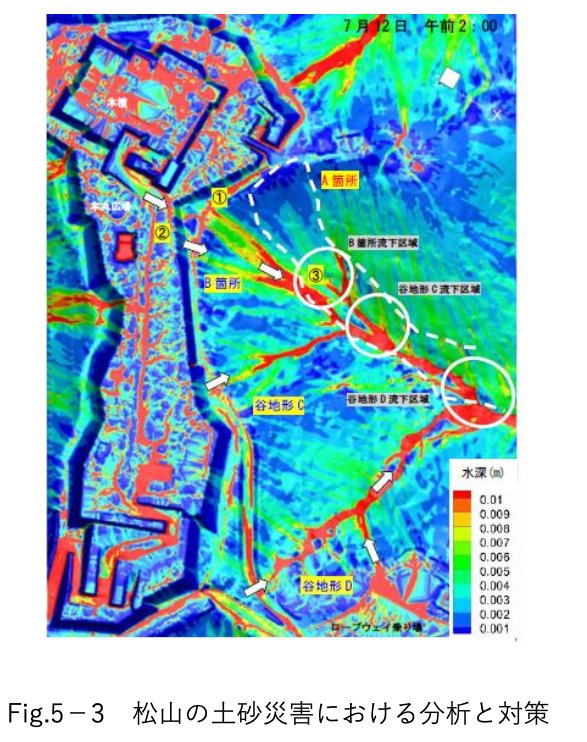
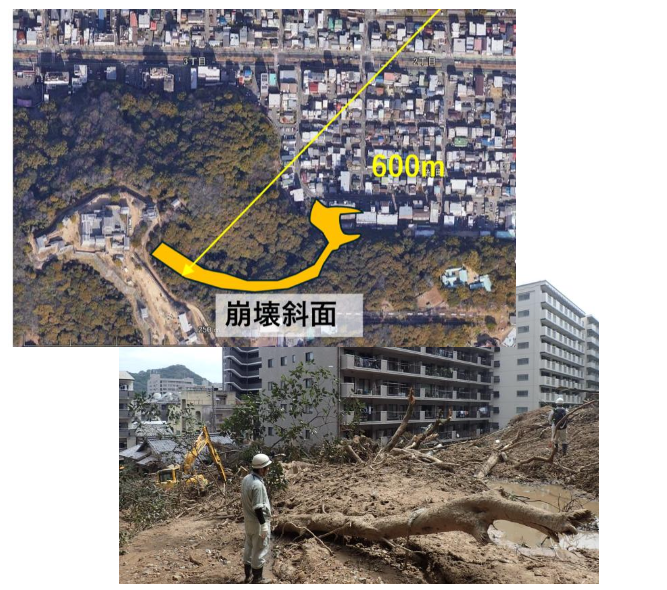
In 2024, Matsuyama City, Ehime Prefecture, was hit by a torrential rain disaster at the end of the rainy season. The disaster was caused by the complex behavior of rainwater and groundwater on the slope where the historic site of Matsuyama Castle remains. We investigated the cause and developed countermeasures to prevent the disaster from occurring again.(Fig5-3)。
➁Model experiment of lateral flow
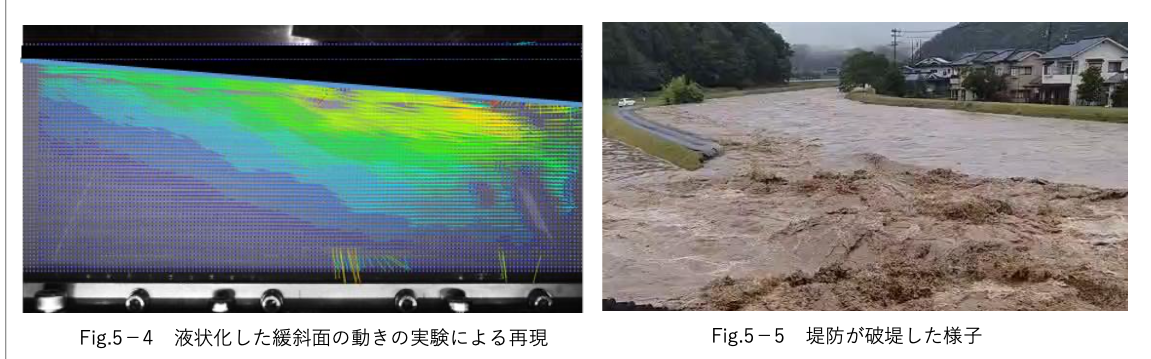
Lateral ground flow caused by liquefaction during an earthquake caused severe damage in Uchinada Town during the Noto Peninsula earthquake. Centrifugal model tests are extremely useful as a method for simulating ground behavior. We are working to further improve this advanced testing technology.(Fig5-4)。
➂On-site survey of the damaged levees
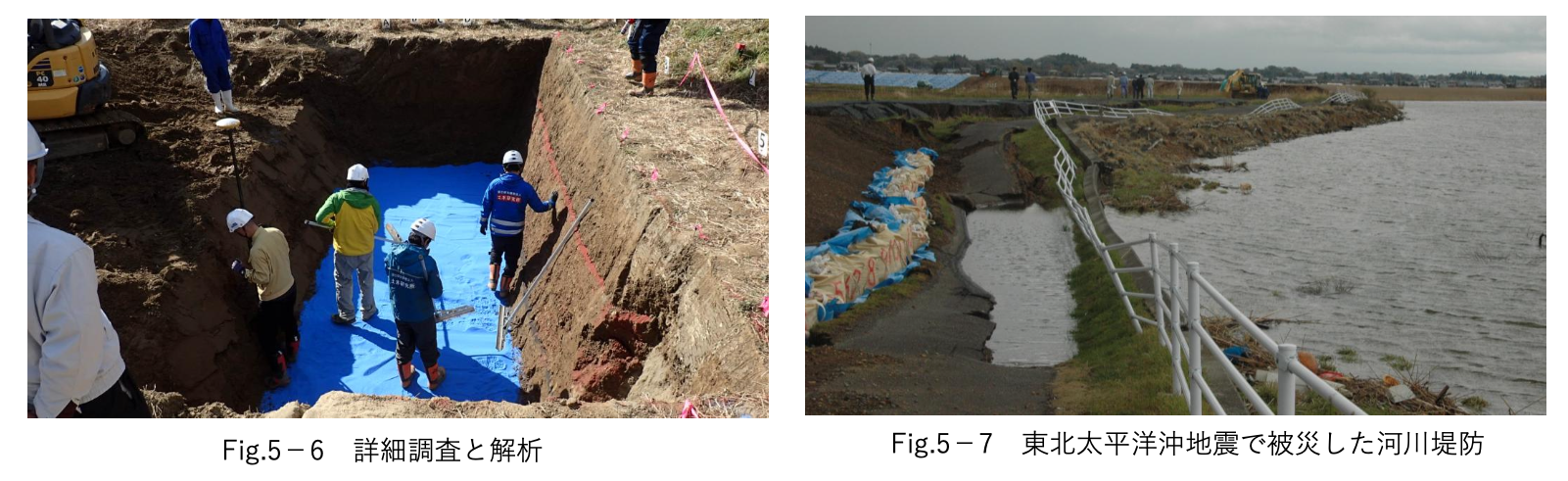
We are investigating the causes (Fig. 5-6) and mechanisms of levee breaches caused by floods (Fig. 5-5) occurring in various locations, and using the results to revise technical guidelines and manuals.
➃Liquefaction damage
Through investigations of river embankments severely damaged by the Great East Japan Earthquake and subsequent earthquakes, we clarified new phenomena occurring within the embankment during earthquakes, leading to revisions of the seismic design guidelines and technical manuals for river structures.(Fig5-7)。