| Elucidation and prediction of seepage failure mechanisms of river levees |
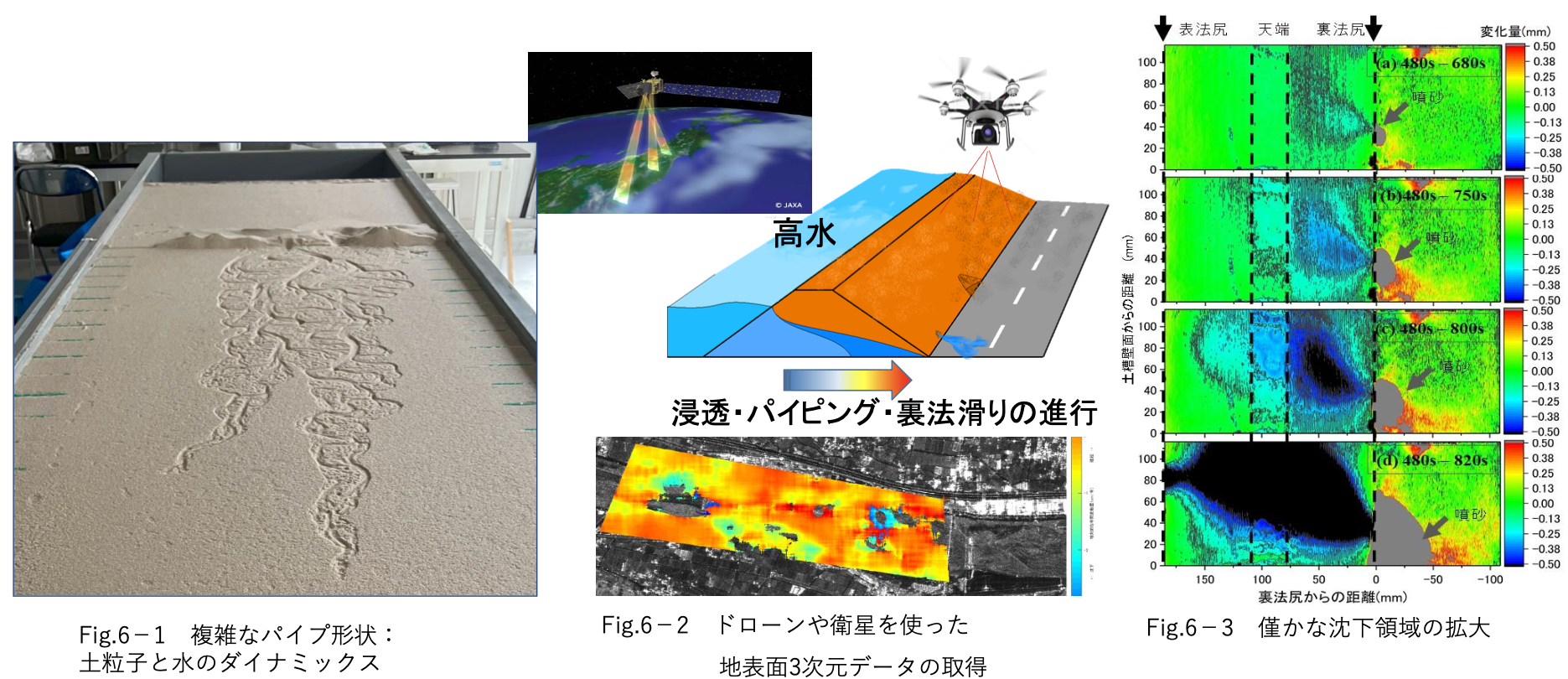
| River levees are breached by the infiltration of river water during floods. Although breaches can occur, it is nearly impossible to accurately predict them based on the latest research and technical reports. In particular, the detailed mechanism of piping failure due to infiltration remains unclear, and many research topics remain. We are conducting research to consider the theory behind this. |
| Detecting internal deformations from minute movements on the ground surface |
Until now, it was almost impossible to detect small movements on the ground surface, but with the use of synthetic aperture radar (SAR) and drones, it has become possible to obtain highly accurate 3D shapes of the ground surface (Fig.6-2). Therefore, we are researching and developing technology to elucidate phenomena occurring within the ground through high-precision measurement and analysis of shapes, and have already succeeded in detecting underground cavities in an actual river, leading Japanese research in this field (Fig.6-3
|
| Innovative liquefaction countermeasures using desaturated ground |
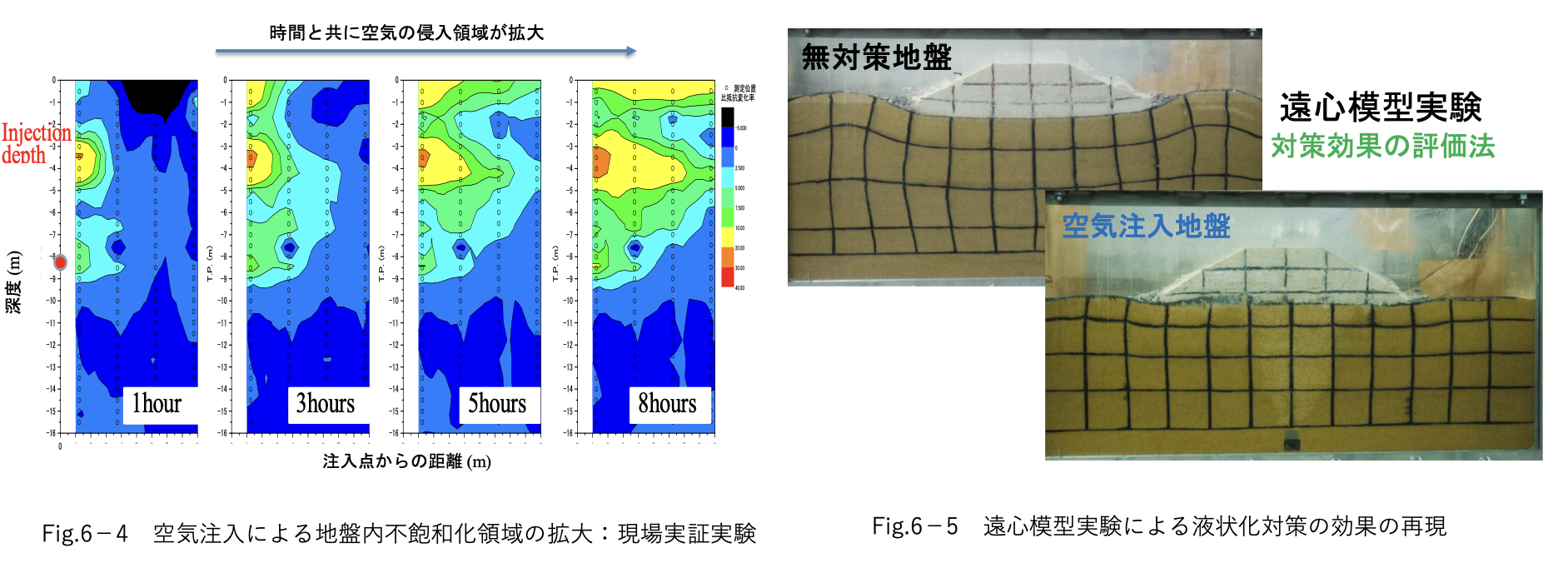
Ground improvement methods used to prevent liquefaction are generally very expensive. Here, we are researching and developing an extremely innovative method that costs less than 1/10 of the cost. This method is beginning to be used for earthquake resistance measures on important sections of expressways and river levees where tsunamis are expected, and we are conducting research with the aim of further reducing costs (targeting 1/50 of the cost of conventional methods) and improving the reliability and long-term sustainability of the countermeasures’ effectiveness (Fig.6-4)
|
| Liquefaction ground behavior by dynamic centrifuge experiment (LEAP) |
Centrifugal model testing is an extremely useful method for simulating ground behavior. We are currently working on further improving this advanced testing technology through international collaborative research with the participation of approximately 15 universities and research institutes in Europe, the United States, and China.(Fig.6-5)。
|